Quebec Dark Triangle still looking for light
Published January 25, 1998 in the Maine Sunday Telegram
by Jack Beaudoin
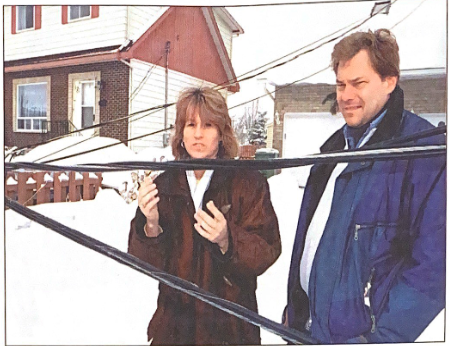
MONTREAL - At the first thundering crash, Lucie Mandeville bolted from her bed to the window. It was unlike any electrical storm she’d ever heard.
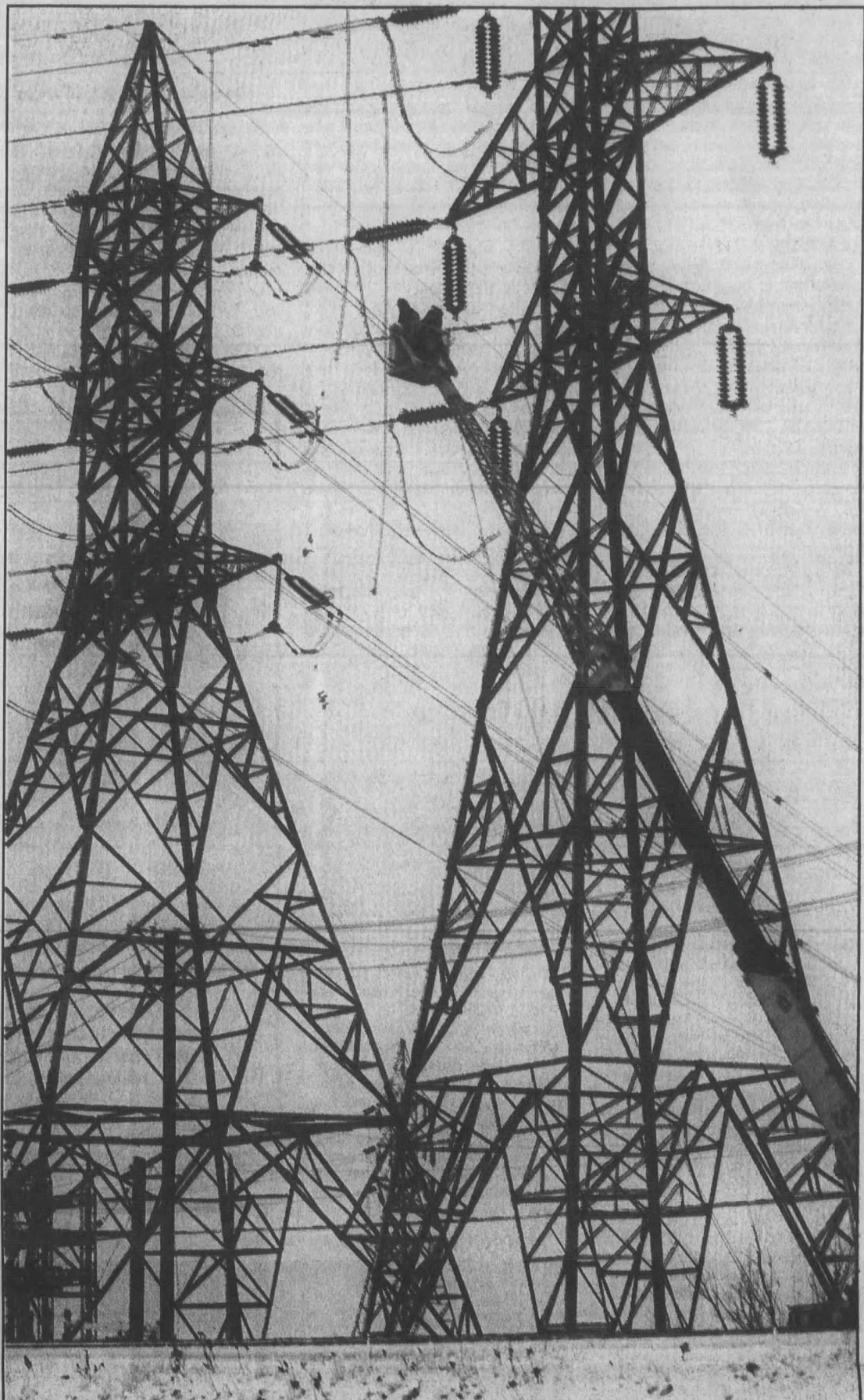
Then, from the early morning Quebec blackness, came a second crash, louder than the first. And then a third. And a fourth. This wasn’t a thunderstorm, Mandeville suddenly realized. The towers were falling.
“Une apres l’autre, comme les dominoes,” she said of the 250-foot latticed steel giants that once spanned the horizon on her family farm. One after another they crashed down, like dominoes.
Within minutes, all but one in a row of 17 electrical towers crossing the Mandeville farm had crumpled to the ground. Six vital power lines, sheathed in a half-foot of ice, snaked through the wreckage. Miraculously, the only tower that remained upright was the one that rose high above Mandeville’s livestock barn.
Such scenes of devastation still plague the Quebec landscape nearly three weeks after a five-day ice storm paralyzed the province.
In Maine, where some 700,000 people lost power - and more than 100,000 were hit again Saturday — the storm was unprecedented. But in Quebec, where 3 million people were left in the dark, the storm was simply unbelievable in its fury.
Mandeville’s farm sits in the middle of what the Quebecois call the “Dark Triangle,” a 290-square-mile area of Montreal suburbs and rural villages that remains without power. While provincial officials and engineers for Hydro Quebec optimistically predict power for the 183,000 residents of the Monteregie region as early as Monday, many residents remain skeptical. They doubt that they’ll have lights and heat any time soon.
“The military just came through and said Feb. 2,” says Monique Granger, who, with her husband, owns one of the few stores still operating in St. Jean sur Richelieu, a town of 20,000 at the southern point of the Dark Triangle. “It’s very bad.”
Morale is suffering
The small Honda generator sputtering outside the door of the Epicerie Jean Granger (the Granger family’s general store) provides enough power to operate one of the store’s three gas pumps, a single fluorescent light overhead, a small glowing space heater and the cash register.
Granger wears a fur coat as she rings up customers who come to buy milk, bread and gas. She finds little solace in cornering the market during such desperate times.
“Business is good for us,” she says. “But I don’t care about that anymore. Morale is suffering. Everybody’s morale is bad. I smile only because I have to.”
Projections from American line crews who have been in Quebec for two weeks are even darker than those from the Canadian army.
“People are coming out of their homes and asking us when the lights will be back on,” says Bob Foell of Connecticut ght and Power. “Forget it, I tell them. Never You might as well move.”
Foell, who erects smaller, wooden street poles, has been working in the Dark Triangle 16 hours a day for the past 12 days.
“All this work,” he says, flipping through a logbook. “All these pages, all these places. … And we haven’t turned on one light bulb. That’s how bad the devastation is.”
“There are no words to describe it,” agrees George Young, a retired lineman living near Granby, who was pressed into service because of the storm. “The destruction is complete. The trees are all down, the fields are coated in four inches of ice. Dairy farmers are dumping milk because they can’t get it processed.”
According to Canadian agricultural officials, the blackout is responsible for the loss of 3.5 million liters of milk and a 20 percent to 30 percent increase in the mortality of farm chickens and pigs.
The province’s maple sugar industry was dealt a knockout blow for 1998. Syrup producers like Denis Dufresne say they don’t know if their trees will ever come back.
“Every one of them is broken in half,” the St. Hyacinthe resident says of his sap trees. This year, my production will be zero. The future? Who can say?”
Thick coat of ice builds
Few Quebecois were prepared for the magnitude of the disaster when a light, unseasonable rain began to fall on Jan. 5 - two days before the first storm reached Maine. Atmospheric conditions supercooled the rain, and the water froze on contact with whatever surface it chanced upon.
Within hours, a thick coat of ice began to build on wires, towers, roofs and roads. Hydro Quebec, the state-owned utility that supplies all the power to the province’s 7 million residents, began to experience patchy outages south of the St. Lawrence River.
Those local outages quickly grew into a quilt of darkness that covered the southern half of the province. At the height of the storm, some 3 million residents were without power, most living in and around Montreal. According to Hydro Quebec’s latest estimates, the utility lost 23,000 street poles and more than 150 “pylones,” or steel towers. Spokesman Richard Charland said his company still has no reliable estimate on the percentage of the 20,000 miles of power lines that are downed and damaged.
“We have not begun to calculate the costs,” Charland said, “but you can be assured it will be counted in hundreds of millions of dollars. How many hundreds (of millions) I’m afraid to guess.” Losing lights was bad, but many of the province’s newer, well-insulated homes relied on electric heat - thanks to Hydro Quebec’s cheap power (about a third of what Mainers pay per kilowatt hour). It wasn’t long before residents were forced to seek generators, just to keep their homes warm. The elderly proved particularly vulnerable.
The ice storm claimed its first two victims on Jan. 6. An 82-year-old St. Angelique resident, Roland Parent, died of carbon monoxide poisoning after running his generator indoors without venting it. In Laval, 89-year-old Joseph Laplante perished in a fire that began in an overheated wood stove.
Others who died in the days that followed included victims of hypothermia, carbon monoxide poisoning, car accidents and ice falling from roofs. In one accident that horrified the nation, a technician who was trying to de-ice a transmission tower died after he fell about 200 feet, in Beauharnois.
In all, 24 Canadians have died so far as a direct result of the ice storm. Another 700 have been treated for carbon monoxide poisoning, said Marc Lavallee, head of Quebec’s “Securite Civile,” the department coordinating the response effort.
“Three times that number have been treated for hypothermia and various stages of frostbite,” Lavallee said.
Hydro Quebec crews, hampered by frigid temperatures in snow squalls, didn’t gain much ground in the days immediately after the storm. But by Jan. 15, the utility had managed to restore power to all but 800,000 residents. That number dropped to about 230,000 by Jan. 19, two weeks after the first ice began to form.
That’s little solace for the people who remain in the dark.
“It’s like a giant ice monster came through Quebec and stepped on everything we had,” said Charland, the Hydro Quebec spokesman. “It’s a cold hell.”
Wood rationing begins
The 5:30 p.m. journey to the “Galeries St. Hyacinthe,” a shopping complex on the order of the Maine Mall, has become a daily routine for Gerard Morin, the owner of a home decorating shop in St. Hyacinthe. Each night, he drives behind the mall to a parking lot littered with mounds of firewood. There, army troops direct traffic into the lot, and homeowners lucky enough to own wood stoves collect their daily allotment of fuel - one trunkful.
“It’s terrible,” says Morin, as he and his wife scavenge among the heaps of scrap wood for a decent log.
Snow is falling in a surreal darkness broken only by a floodlight hooked up to a generator.
“This can’t go on forever,” Morin says.
Yet it does. St. Hyacinthe, a city of 41,000, holds the dubious distinction of “hardest hit” community in the Dark Triangle. About 10,000 residents have fled the city, according to Nicole Franc, communications director of St. Hyacinthe’s emergency team, and another 5,000 are living in temporary shelters.
In fact, the flow of power coming Into the city on a temporary line is so fragile that the regional hospital isn’t allowed to hook up. Instead, it relies on an overworked generator while the transmission line routes power to the shelters.
For the 26,000 St. Hyacinthe residents living in their own homes, or bunking with friends and neighbors, optimism and communal bon esprit were among the first victims of the prolonged disaster. The trip to the wood pile, or to the “general store” provisioned by emergency authorities, is the only distraction in the relentless freeze.
“I’ve lost all my food,” says Denis Houle, a truck driver who visits the mall parking lot each night. “I melt ice for water… It’s no way for a family to live.”
“There’s some tension,” admits Franc. “Everybody’s anxious. Everybody’s tired. Everybody wants to believe this will end on the 25th, as Hydro Quebec says… But it’s hard to live with 600 or 700 other people in a shelter.”
Last week, Franc said St. Hyacinthe officials held a “hamburger party” exclusively for residents who are not staying in the shelters. “We served 3,300 hamburgers in one day,” she says. “But more impor antiy, we got them out of their houses.”
Patrice Furlan, St. Hyacinthe’s city planner, has been coordinating efforts at the woodpile. Volunteer woodcutters arrive every day to cut and split the 400 cords trucked in from other parts of the province. We have to limit people to just one trunk a day,” Furlan says. “Unfortunately, we had some people who were abusing the system and had to be thrown out This wood is for emergency use now, not to restock a private woodpile or save up for next year.”
But Furlan has been impressed with the cooperation of most citizens. And, he adds, the city’s finely tuned emergency preparedness team has won good reviews from residents as well as the provincial government. They are calling our response a model for the rest of Quebec,” Furlan says proudly.
‘Operation Door-to-Door’
If any city could contest St. Hyacinthe’s hardship title, it would be St Jean-sur-Richelieu, the extreme southern point of the triangle. St. Jean’s downtown has been coated in ice since the start of the storm. Few utility poles have remained undamaged by the storm.
On many streets, broken poles and downed lines fence suburbanites in their homes. There is no thought of repairing the local distribution network says Connecticut Light and Power worker John Greico. It will have to be replaced. In addition to the St. Jean police, members of the Montreal police force and the Royal Canadian Mounted Police have been working on “Operation Door-to-Door,” checking on residents holed up in their homes.
They carry candles, batteries and lamp oil - and warnings about improperly ventilated generators and cook stoves.
But many of the citizens of St. Jean have either left town or moved to two large shelters. At the storm’s peak, about 1,000 residents slept, ate and showered at a shelter at a former military college. More than 600 remain. Officials at the school have created a mini-city center at the shelter, operating a cafeteria, barbershop, movie theater and daycare center.
“We try to do everything, but of course that is impossible,” says school director Gerald Brassard. “Now we’re trying to make meals for the entire population.”
That may be diffcult. Last week, for the first time since the storm began, demand for food in the affected areas outstripped donations.
The provincial government bought 250,000 dozen eggs, 250,000 hamburger patties and 15,000 kilograms of kerosene and lamp oil for redistribution in the Monteregie region. But, Lavallee notes, that will not be enough for needy residents.
And despite the best efforts of Brassard and his team, the shelter’s residents are getting tired of the routine. Some booed the announcement that government relief checks - worth about $50, in US. moneywould be issued across town and not at the shelter.
“What can I tell you,” shrugs Bruce Jacobson, a former Massachusetts resident who lives in St. Jean. “The days are long and tedious, and I’m fed up. We’ve been here since day one. Everybody just wants to go home.”
Publication data
title: Quebec’s ‘Dark Triangle’ still looking for light
date: January 25, 1998
outlet: The Maine Sunday Telegram
words: 2040
url: Unavailable
related: Lifelines of the north no match for nature, Frost in Pumpkinville, but residents stay put