A deep dive into third party requests in Deer Isle and Stonington
Voters keep supporting nonprofits, but officials wonder when does it stop?
February 19, 2026
BY WILL ROBINSON AND JACK BEAUDOIN

THE ISLAND—In the run-up to next month’s annual town meetings in Deer Isle and Stonington, it’s a rare select board meeting that hasn’t grappled with concerns over funding for nonprofits. Warrant articles (or referendum questions) that ask taxpayers to give funds to nonprofits, often referred to as third-party requests, have come under increased scrutiny as elected officials struggle to keep a lid on property tax hikes in the coming year.
In Deer Isle, Select Board member Peter Perez argued that third-party requests represent an unnecessary cost to taxpayers. Perez said any budget increases, however small they look in comparison to the much larger school budget or county tax, contribute to higher tax bills.
Some organizations “are just looking at the town as a bank,” Perez said. “It’s just getting carried away.”
“The original intent of the process seems to be about filling gaps in municipal services that the town would otherwise have to stand up on its own in a more financially efficient way and in most cases it does exactly that,” said Travis Fifield, a Stonington select board member. But today, he added, “It feels like the third-party request system for some of these groups has become just another annual fundraising tool for general operating expenses. The requests seem too easy and too frequent and the generally accepted reason for needing the money has changed.”

“When does it stop?” Stonington Select Board Chair Donna Brewer said in a November discussion on the topic. “They all do good work, but I think it has gotten out of control.”
But nonprofit leaders say that while they understand the concerns, most organizations are not requesting more money year after year. And those that are seeking increases in 2026 defend them by pointing out that they provide essential services that have been cut from state and federal programs.
Healthy Island Project, for example, has had some of the largest increases in its funding requests in recent years. In 2019, HIP asked Deer Isle taxpayers for $3,500. This year, it is requesting $12,600 from both Deer Isle and Stonington.
HIP Executive Director Rene Colson said the upped requests are tied directly to HIP’s massive expansion over the past seven years. Today, HIP organizes and oversees a growing list of social services on the Island, including the annual winterfest celebration, a food pantry, hunger-prevention programs for school-aged children, and social activities and meal deliveries for elderly residents.
“Our services are continuing to expand because of gaps in services that were provided often by other organizations that are no longer able to service the community,” Colson said.
With many of HIP’s services and programs coming at no or low cost, Colson felt the yearly donation to her operation was “a very good deal.”
But town officials counter that the overall impact of third-party requests have reached a breaking point. In order to keep taxes affordable, they are cutting or delaying essential town services because they have no control over the nonprofit component of the budget.
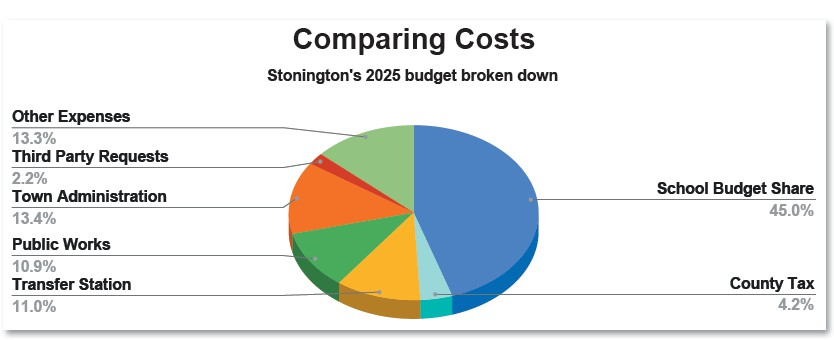
In a February interview, Stonington Town Manager Kathleen Billings said that initial inquiries amounted to $104,000, but because some organizations failed to follow through, the 2026 requests now total $87,100. When she first started as town manager in 2009, she said third-party requests amounted to about $40,000.
In Deer Isle, the total amount requested by nonprofits was about $57,000 in 2019 and has gradually increased every year since. Total requests peaked at $69,000 in 2025 and are back down to $63,340 this year, an eight percent decrease.
Island Ad-Vantages reporters launched a month-long investigation into the scope and impact of third-party requests, analyzing the last five to seven years of town data and conducting interviews with nonprofit leaders, elected officials and town administrators. Here is what we found.
Why are towns focusing on third-party requests now?
It’s all about annual property taxes. Although the town sends out property tax bills each year, the amount due includes three parts: municipal taxes, taxes for schools and the county taxes. Since they have no say in the school or county budgets, town officials have just one option when it comes to controlling tax rate hikes—the municipal budget. So each year the town administrators and select boards look for savings or cuts in town services such as public works, transfer station expenses and public safety. An increase in one area might require a decrease in another line to balance the budget.
But third-party requests bypass the standard budget process. Unlike the balancing act the select board engages in, these requests go directly to town meeting voters.
“What the select board is having to weigh is how each increase and request affects the bottom line for its most vulnerable residents,” Fifield said. In contrast, voters view each third-party request in isolation, “and what taxpayers need to decide is if there is truly a net social service benefit.”
Since the submitting organization decides how much to ask for, every dollar approved is tacked on to the municipal budget, and thus on to the tax bill. From the point of view of the towns, “it puts pressure on us to cut essential services,” Billings said, noting that every tax increase makes it harder for residents to afford living on the Island. “I’m on nonprofit boards myself, so I get to see both sides of it. But we have a lot of responsibilities in this small, little city.”
Why do nonprofits request taxpayer funding?
Nonprofits seek taxpayer support for a variety of reasons. According to new library director Ethan Yankura, who joined the organization at the start of 2026, the Stonington Public Library doubled its 2024 request from $12,500 to $25,000 to increase its hours of operation (and consequentially, additional staff time and expense) especially in the winter time. It also aimed to increase the availability of online magazines and newspapers, e-books, audio books, video and WiFi to year-round residents at no cost — helping to bridge the “digital divide.”
Opera House Arts Erika Sanger said her organization’s $7,500 request (which has not increased since 2024) makes up only about 0.5 percent of the organization’s budget, most of which comes from foundation support and state grants. But its impact is significant. Many foundations require evidence of community support in their grant applications. The support also has helped the Opera House avoid ticket increases, which make up just 16 percent of the organization’s annual revenue. And it enables the Opera House to offer more events at the $5 or pay-what-you-can level, which Sanger says makes events affordable for year-round families.
“We’re removing as many of the financial barriers as we can,” she said.
Another argument is that, in a town that’s struggling to maintain its year-round vitality, nonprofits provide fulltime jobs for residents, pump money back into the local economy, and generate demand for the Island’s businesses in the winter and shoulder seasons, when restaurants and motels see a noticeable bump in business from events.
In the summer time, the Island’s scenic trails, museums, musical performances, plays and art shows draw tourists to the town — who then buy their food, gasoline, and other goods and services right here.
Island Workforce Housing, a nonprofit that now runs two apartment complexes on the Island, is asking each town for $6,000 this year, the same amount it’s asked for since 2023. IWH Executive Director Pam Dewell said taxpayer funds are applied to the multi-million dollar construction cost for IWH’s new 12-unit complex in Stonington.
IWH apartments are rented on a sliding scale based on income and are only open to people who work in Deer Isle and Stonington. The town contribution may be a relatively small investment, but Dewell said the community sees a much larger return in the form of affordable housing.
“We see ourselves as an important component of the economic development of the Island,” Dewell said. “We’re providing housing to teachers, restaurants, staff, fishermen, tradespeople, and their families. And many of these people would likely be living off-island if they had not been able to find housing that they could afford.”
Money also flows back to the community in other ways. Sanger said the Opera House expended $67,000 on local building trades companies, paid $7,800 in water and sanitation bills and another $6,300 in other municipal fees.
“We put money into the town economically,” said Sanger, who is working with the University of Maine to help quantify the economic impact of nonprofits on local communities. “Economists there said they wouldn’t be surprised if the town earned seven times the amount of each dollar invested.”
Do third-party requests have a big impact on tax bills?
It probably depends on what feels like a “big impact” to individual taxpayers, and how you calculate it.
“Whether taxes are ‘affordable’ or not totally depends on that taxpayer’s income, and frame of reference, right?” Fifield asked. “If you’ve moved here from New York City, or really any other even medium-sized city, you probably think our taxes are comparatively low. But if you’re in the tax installment club, and $100 is the difference between hanging onto your property or a tax foreclosure, then even these low dollar amounts are real money and can mean the difference between fully paying taxes or not.”
Even with outlying low and high years, third-party requests generally make up between 1 to 2.5 percent of the total budget in both towns. This seemingly small percentage means changes to third-party requests have an equivalent impact on individual tax bills.
According to Deer Isle Town Manager Jim Fisher, changes in big-ticket line items like education—the largest expense in both towns—administration and waste removal are the usual suspects when it comes to tax hikes in Deer Isle.
“[Third party requests] are a relatively small part of the budget,” Fisher said. “They may go up a few thousand or down a few thousand, but in the meantime the school budget might go up $500,000. Compared to our largest costs, they don’t make much difference.”
But it’s also clear that Billings isn’t wrong about the general trend in the third-party request lines. In 2019, Stonington third-party requests totaled $67,094. In five years, that total climbed to $97,085—an increase of about $30,000, or nearly 45 percent. It’s only because some organizations went under, or failed to make requests this year, that the 2026 number ($87,100) is lower.
“Some people say this is just pennies on your tax bill, but that’s not the way it works,” Billings said at a recent public hearing on third-party requests.
The data shows that most of the growth in Stonington’s third-party requests since 2020 have come in two specific budget years. In 2020, new requests from the Island Nursing Home and Island Workforce Housing added $10,000 to the budget. In 2024, a new $7,500 request from Opera House Arts and a $12,500 increase in the Stonington Public Library’s request added another $19,000. Those two years account for nearly all the five-year growth in third-party requests.
In the remaining years, increases and new requests often balanced out, so overall requests did not grow by more than 1.8 percent, and actually decreased three times. In 2026, third-party requests in Stonington are $9,894 lower than in 2025, mostly because two organizations were essentially shuttered, and another failed to submit its paperwork.
Don’t towns support nonprofits in other ways?
One aspect both Deer Isle and Stonington officials have highlighted is that taxpayers already support some—but not all—nonprofits through property tax exemptions. In 2026, four of the 17 third-party requests on the Stonington warrant came from organizations that own property in town, but pay no property taxes. In Deer Isle, only one of the 14 requesting organizations this year, Island Workforce Housing, owns tax-exempt property in town.
Under Maine Revised Statutes, Title 36 (Taxation) §652, the state grants this exemption to charitable nonprofits because they relieve towns of the burden of providing services directly. In other words, by providing social services, health centers, or low-income housing, nonprofits may reduce the need for taxpayer-funded programs. The tax exemption is essentially a trade-off: the municipality loses tax revenue but gains a service that benefits its residents. In order to get the exemption, nonprofits need to demonstrate that their services provide the benefit.
Why don’t towns change the request process?
No one interviewed for this story suggested a ban on third-party funding requests. But town officials have often discussed the process, and suggested changes.
“Getting back to the core intent of the third-party request mechanism is what I would ideally like to see,” Fifield said. “Further, the town can and should help to get some of these new organizations off the ground but then they need to figure out how to self-sustain without tax payer seed money. If, however, we’re going to be perpetually stuck in this poorly defined process, then we need to formalize what really is a continuous, low barrier, grant program.”
Without a change to prevailing laws, Fifield said the process will encourage “creep”—year after year of increases.
There has been at least one change instituted to curb that growth. In recent years, most of the requests have been moved from town meeting warrants, which were debated in public, to referendum ballots cast in secret.
“People came in and said they didn’t want to go into an opening meeting and ask questions about requests,” Billings said, explaining the change in Stonington. “They didn’t want to argue on the floor, because asking questions has repercussions.”
“People are more likely to vote based on how they really feel in a referendum,” Fisher agreed back in November at a Deer Isle select board meeting. “There can be a fair amount of peer pressure to vote a certain way at Town Meeting.”
But the move to secret ballots has made little difference to the outcome. With very few exceptions, a large majority of voters support third-party requests either in the voting booth or on the town meeting floor. Most requests pass with majority support every year.
There are currently no state laws specifically regulating third-party funding requests made to municipalities, according to the Maine Municipal Association. This means individual towns and cities largely set their own policies on third-party funding. Elected officials in both towns have brainstormed ways of regulating third-party requests. These include:
-
Giving voters a way to allocate funds from a budgeted pool for third-party requests.
-
Providing more context about past requests and property tax exemptions on the warrant.
-
Requiring more direct communication and details from requesters about planned increases.
-
Putting caps on individual increases over a period of time.
-
Making organizations submit new petitions if they want to up their request.
Billings said that the form of municipal government in Stonington and Deer Isle makes any efforts to limit requests difficult to implement. Any individual or group may submit a petition to put an article up for a town meeting vote. Even if Stonington or Deer Isle enacted a new process for third-party requests, that process can always be bypassed by a petition.
For now, Billings said the best solution is for voters to educate themselves and play a more active role in town affairs, whatever their positions on issues like third-party requests. Right now, only about 10 percent of voters are deciding the annual budget, Billings said.
When Deer Isle voters walk into the polls this year, Perez said he hopes “people stop and think about how these organizations are spending their money.”
For their part, nonprofit leaders welcome the scrutiny and the invitation for better communication.
“I appreciate the transparency of the process,” Sanger said. “We have to make the case about why we are important to this town.”
Colson said her organization and others like it on the Island don’t have many opportunities to communicate with town governments. If select boards decide to change their policies, she hopes they keep HIP in the loop.
“We could have a conversation and a meeting and work together around a table to discuss some options,” Colson said.
Publication data
title: A deep dive into third party requests around Deer Isle, Stonington (Special Focus)
date: 2026-02
outlet: Island Ad-Vantages
words: 2725
file: a_deep_dive.pdf