Lifelines of the north no match for nature
*Published January 25, 1998
by Jack Beaudoin
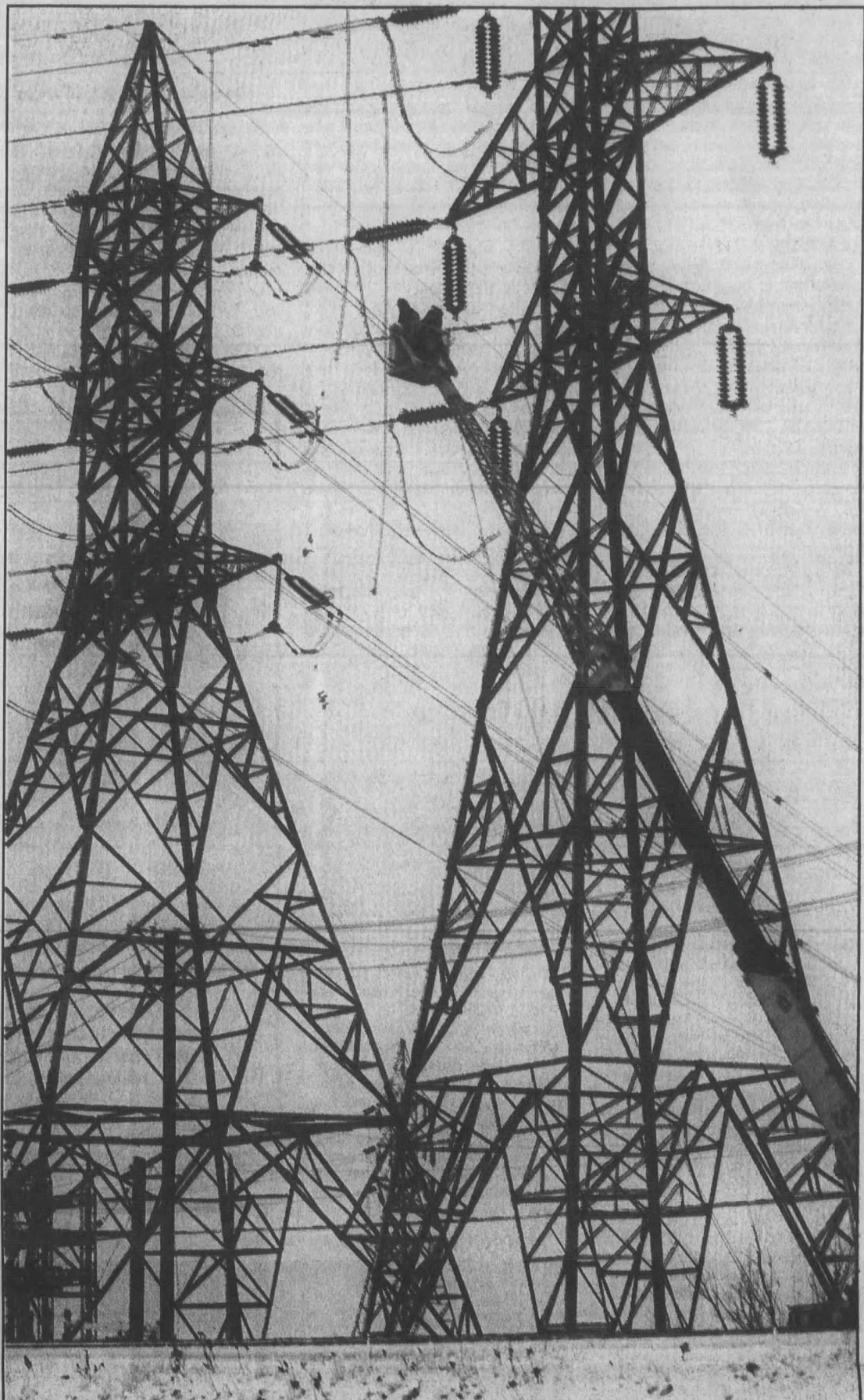 Hydro Quebec linesmen reattach power lines to two “pylones,” as the Quebecois call the steel towers, on Thursday outside St. Hyacinthe, one of the hardest-hit areas in southern Quebec.
Photo by Gordon Chilbroski
Hydro Quebec linesmen reattach power lines to two “pylones,” as the Quebecois call the steel towers, on Thursday outside St. Hyacinthe, one of the hardest-hit areas in southern Quebec.
Photo by Gordon Chilbroski
MONTREAL - Seven gargantuan power lines traverse the desolate, sparsely populated region between the James Bay hydroelectric complex and Montreal. Another three lines run nearly 1,000 miles from a generation complex in Churchill Falls, Labrador, to lower Quebec.
For most of Quebec’s 7 million residents, these are lifelines from the north, conveying enough power to light 363 million light bulbs at the same time.
But when the great ice storm struck during the first week of January, there wasn’t enough electricity reaching Montreal and its environs to warm a day-old croissant. The man-made xlifelines of the north had fallen victim to an unprecedented freak of nature.
“We were particularly vulnerable to the ice storm,” admits Hydro Quebec spokesman Richard Charland. “About 95 percent of our generating capacity comes from hydro plants in the north, but more than half of Quebec’s population lives in or near Montreal. All those wires… you can imagine what happened.”
What happened was this:
On Jan. 6, up to six inches of ice began to form around the lines, poles and insulators, and the tall latticed steel towers began to creak As the weight of the ice on the lines increased geometrically with each fresh coating of ice, the weakest of the towers toppled.
In some cases, the first tower down set off a chain reaction, pulling down with it as many as 20 towers in a row, and stopping only when the high-tension lines finally snapped. In other cases, Charland says, the “pylones,” as the Quebecois call their towers, simply disintegrated, telescoping down upon themselves in a sudden, metallic fury. More than 500 will have to be replaced.
It would be difficult for critics to blame Hydro Quebec - the world’s eighth-largest power generator for being ill-prepared. Canada’s engineering guidelines call for towers to be able to bear the weight of at least a half-inch of freezing rain. Hydro Quebec builds its towers to bear the weight of two inches of freezing rain. In some places, engineers reported lines encased in a half-foot tube of ice.
The desolation of the Quebec grid extends beyond the giant transmission lines. In an area known as the “Dark Triangle,” towns and small cities like St. Jean-sur-Richelieu and St. Hyacinthe have seen their own internal distribution network utterly destroved. More than 23,000 of the small “cross-T” utility poles found on every street are beyond repair.
“I know what I’m telling my boss when I get back,” said John Greico, a lineman for Connecticut Light and Power who has been in the Dark Triangle for two weeks. “Try to build for a 100-year storm? Forget it It’s impossible. You can’t build for a storm like that.”
However, some politicians are saying Hydro Quebec needs to revisit its strategic plan in light of the storm.
They say building more hydroelectric plants in the north - far away from population centers in Montreal and Quebec City - sets up the government-owned utility for a repeat of this disaster.
“A real post-mortem has to be done,” Quebec’s former energy minister, Christos Sirros, said last week. “Somebody has to look at this event. analyze it and draw some lessons.”
 Hydro Quebec spokesman Daniel Giguere, at one of the utility’s two daily press conferences, explains the condition of areas still without power. With him are Jilles Bernier, left, a water quality expert, and Major Marc Rouleau of the Canadian army.
Photo by Gordon Chilbroski
Hydro Quebec spokesman Daniel Giguere, at one of the utility’s two daily press conferences, explains the condition of areas still without power. With him are Jilles Bernier, left, a water quality expert, and Major Marc Rouleau of the Canadian army.
Photo by Gordon Chilbroski
Publication data
title: Lifelines of the north no match for nature
date: January 25, 1998
outlet: The Maine Sunday Telegram
words:
url: Unavailable
related: Quebec Dark Triangle still looking for light, Frost in Pumpkinville, but residents stay put